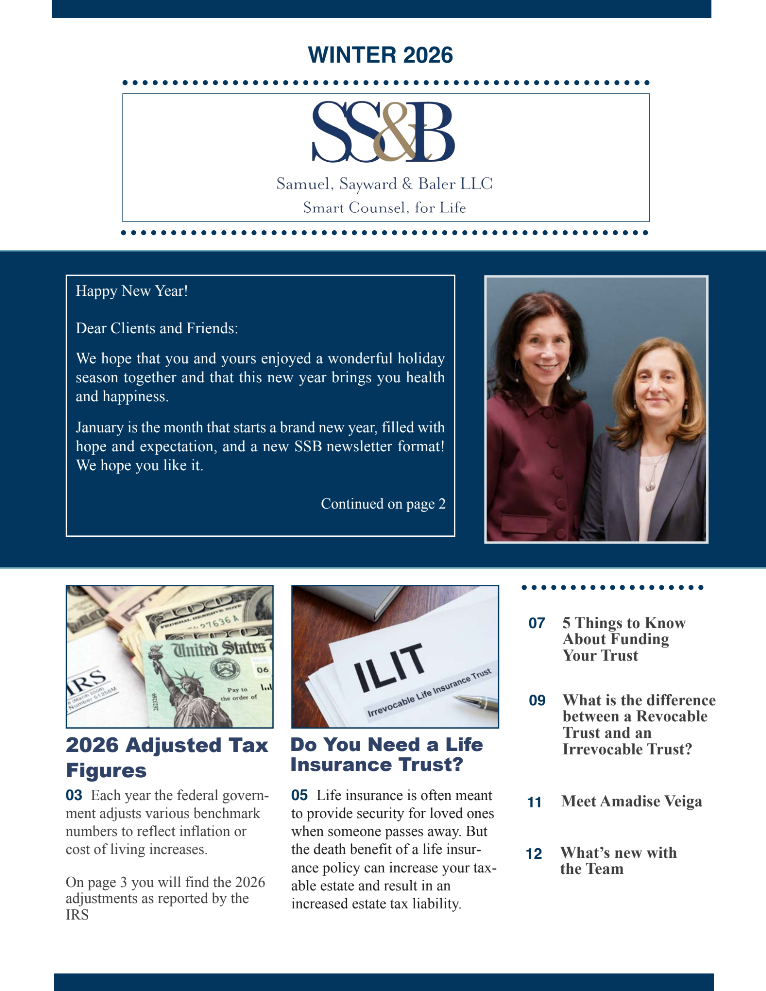
Attorney Sean Downing discusses our Winter Newsletter, for our Smart Counsel for Lunch Series. Please watch and if you have any questions or want to learn more please call us at 781 461-1020.
by Sean Downing
by Sean Downing
Happy New Year!
It’s now 2026, and many of us are looking for ways to start the new year on a good foot. In this week’s article, we look at 5 Estate Plan New Year’s Resolutions.
1. Review/Update your Estate Plan
After setting up your estate plan, it’s nice to sit back and take a sigh of relief. However, your estate plan is not something you should neglect after completing it. Every couple of years or so (or after any major event in your life), you should review your estate plan to see if (a) your named fiduciaries still make sense, and (b) your distribution of your assets after death is still what you would like. For many families, there are two major transition points where they change their fiduciary designations from parents to siblings/friends and then from siblings/friends to their adult children. Marriages, births, and deaths in your family can also spark needed changes.
2. Organize Financials/Passwords for Fiduciaries
A comprehensive estate plan will have fiduciaries listed to help you if you become incapacitated and to manage your affairs after you’ve passed away. These agents have important jobs, and the best thing you can do to thank them is to organize your financial information and passwords in advance. Creating a spreadsheet of your financial accounts (including bank, retirement, investment, etc.) can be invaluable to the person who steps in to manage your affairs. In a similar vein, creating a system to allow others to access passwords to your email and other online accounts can make payments like utilities much easier for them.
3. Trust Funding
If you created a trust as part of your estate plan, it is important to make sure your trust is funded properly. “Funding” a trust means to assign title of assets to your trust or to list your trust as a pay-on-death or transfer-on-death beneficiary. If your trust is not properly funded, assets may need to pass through your estate to get to your trust. This means that those assets will need to go through probate (often a major purpose of creating a trust is to avoid probate). You should reach out to your estate planning attorney with any trust funding questions to make sure you are optimally funding your trust.
4. Give Out Health Care Proxy
Your Health Care Proxy is your true “emergency” estate planning document that allows your listed Health Care Agent to make health decisions for you when you are unable to do so yourself. Because it may need to be activated unexpectedly, it’s important that your Health Care Proxy is accessible to others. We recommend that all your Health Care Agents, including back-ups, have copies (PDFs are fine) of your Health Care Proxy. We also recommend that you give a copy of your Health Care Proxy to your doctors (often this can be done online by uploading it to your Health Portal). Some phones also permit you to have a copy of your Health Care Proxy easily accessible in an app.
5. Talking with your Family about your Estate Plan
Talking about death and incapacity can be a difficult conversation, especially with your closest loved ones. However, for older clients in particular, having these discussions with your loved ones while you are able and healthy can make future trials easier on everyone. In this way, finding time to sit down with your family to review your estate plan can be extremely beneficial. Another similar approach that people take is to write letters to your loved ones to include in your estate plan binder. These letters can explain uncomfortable realities in your estate plan such as unequal distributions, favoring one child as a fiduciary over another, etc., and can do a lot to reduce tension after you pass away.
by Sean Downing
Most people feel honored to be named as a successor Trustee as it signifies that the grantor (trust maker) has great faith and confidence in them. However, with that honor comes a lot of responsibility and potential liability if the Trustee does not carry out their duties properly and timely.
Here are five tasks that a successor Trustee typically must take care of soon after the grantor dies.
1. Engage an experienced trusts and estates attorney. One of the first steps that a successor Trustee should take is to hire an experienced trusts and estates attorney. While serving as Trustee is an honor and can be a rewarding experience, it is also a new experience for most family members or friends who are named to this position. There are significant responsibilities that a Trustee must carry out, some of which are time sensitive. Engaging an experienced estates and trusts attorney will protect the successor Trustee from liability by ensuring that they are properly advised as to their duties.
2. Review the Trust. Although it may seem obvious, one of the first things a successor Trustee should do is read the Trust, including all amendments. Think of the Trust document as the instruction manual from the grantor. The Trust will identify the beneficiaries, set forth the distribution instructions, direct how the assets are to be managed, and grant the Trustee the authority to act on behalf of the Trust. One of the first tasks of the successor Trustee is to update the Trust documentation to reflect that he or she is now the Trustee and to obtain a taxpayer identification number for the trust. The estate and trust attorney will assist with these tasks.
3. Notify interested parties. While each state will have specific requirements for notifying beneficiaries and/or interested parties, most states require that the Trustee provide notice to the Trust beneficiaries. In Massachusetts, trust law is governed by the Massachusetts Uniform Trust Code which requires the Trustee to send written notice to the beneficiaries within 30 days of the Trustee’s appointment. The notice must inform the beneficiaries that they are a beneficiary under the Trust and must provide the beneficiaries with the name and contact information for the Trustee.
4. Secure and inventory all Trust assets. Once authority to act as Trustee has been established via the successor Trustee documentation, the next job of the successor Trustee is to identify the Trust assets and obtain access to those assets. Trust assets may include bank accounts, investment accounts, real estate, and life insurance or other assets that name the Trust as the beneficiary. The Trustee will need to contact the financial institutions to update the Trust accounts with the new taxpayer identification number and to add themselves to the accounts. The successor Trustee should obtain date of death values for the Trust assets. This is important not only for the purpose of accounting to the Trust beneficiaries but for tax purposes. Date of death values can be obtained from the financial institutions with respect to bank accounts and investment accounts. For real estate, the Trustee will need to arrange for an appraisal of the property.
5. Identify time sensitive tasks. The successor Trustee should work with the trusts and estates Attorney to create a timeline of deadline driven tasks. These may include making sure the decedent’s required minimum distribution from his retirement account is made, filing personal income tax returns for the decedent, filing income tax returns for the trust, filing an estate tax return, if required. In addition, there may be ongoing expenses that need to be paid such as a monthly mortgage payment or car payment. It is important for the Trustee to understand their obligations to pay, or not to pay, debts of the decedent. There are also time frames for making distributions to the beneficiaries named in the trust. Missing these deadlines can result in penalties and interest for which the Trustee may be personally liable.
Most people feel that being named as Trustee is a great honor. It means that the trust maker had faith and confidence that you could perform the duties and responsibilities required by the job. Live up to those expectations by following the terms of the Trust and carrying out the trust maker’s instructions.
Attorney Sean M. Downing is an associate attorney with the Dedham, Massachusetts law firm of Samuel, Sayward & Baler LLC, which focuses on advising its clients in the areas of trust and estate planning, estate settlement, and elder law matters. This article is not intended to provide legal advice or create or imply an attorney-client relationship. No information contained herein is a substitute for a personal consultation with an attorney. For more information visit ssbllc.com or call 781-461-1020.
December 2025
© 2025 Samuel, Sayward & Baler LLC
by Sean Downing
People often come to us with a desire to create an estate plan that avoids probate, the court process of transferring assets from a deceased person to that person’s beneficiaries (the people named in the deceased person’s Will or the heirs at law if there is no Will). However, they don’t always know why that’s something they should want. Here are five reasons to avoid having your assets pass through probate.
Under Massachusetts law, creditors have a whole year after someone dies to make a claim against that person’s estate. What this means is that probating someone’s estate takes at least a year to complete. Waiting for a year can be extremely difficult when there are dependents waiting on access to the deceased person’s financial assets or real estate.
The courts are also very busy with their dockets and are often quite slow at responding. This means that it may take a while to even appoint someone as Personal Representative (previously called Executor) of the estate. This can be particularly frustrating because the estate is unable to pay final costs, taxes, and lawyer fees until someone is appointed as Personal Representative and has access to the estate’s accounts.
2. Probate can be Expensive
Probates in Massachusetts are not particularly simple or intuitive. Most people will need to hire an attorney to help them navigate the process and fill out the forms correctly. What makes probate particularly expensive though is when the Personal Representative runs into any friction with the court. For instance, if the estate needs to sell real estate before the year is up, they may be able to do so if they petition the court, but this requires a lot of back-and-forth between the attorney and the court. If any of the beneficiaries of the estate push back on the Personal Representative’s actions, this can also create additional work, thus creating additional attorney’s fees.
3. Probates are Public
As part of the Probate process, the Personal Representative needs to tell the court the approximate value of the estate, including the value of any real estate, say who the beneficiaries are, and detail which assets each beneficiary is getting. The value of the estate, the beneficiaries’ identities, and the distribution of assets then become accessible to the public.
In movies and TV shows, this can reveal hidden affair children or dramatic disinheritances. For most people though, this is just an issue of privacy. Do you want everyone to know which charities/organizations you supported? Do you want everyone to know that you gave more money to your favored niece than to her siblings? Having privacy regarding these matters by using a Trust can lessen familial drama after you pass away.
4. Probates are More Easily Contestable
All legal documents can be contested in theory. However, Wills are particularly prone to being contested. Besides Wills being publicly accessible, all heirs at law are given notice of the probate at the beginning as part of the procedure. These two factors combine to create an environment where jilted beneficiaries are given the information and venue they need to contest.
Trusts, unlike Wills, are not publicly accessible and do not require notice to heirs at law. This makes it difficult for disgruntled family members to know the contents of the trust or how their treatment under the trust compares to other parties.
5. Probates Require Court Supervision
Probate is inherently a court process, and the judge is in their power to add extra supervision over a probate. The most common form of this is a Guardian Ad Litem, which is a person appointed by the court to act in the interest of a minor child or otherwise incapacitated person. Guardians Ad Litem must conduct interviews and make formal reports which can be slow and expensive. Courts can also demand bond be paid, searches for potential heirs at law be conducted, and accountings for the estate be completed, all of which add to the time and expense of probate.
by Sean Downing
Attorney Sean Downing discusses What is Probate? on our Smart Counsel for Lunch Series. Please watch and if you have any questions or want to learn more please call us at 781 461-1020.
by Sean Downing
This week we feature Attorney Sean Downing’s Smart Counsel interview with Chelsea Lanson from HESSCO. Sean and Chelsea discuss HESSCO’s services.
HESSCO is the Aging Services Access Point (ASAP) and Area Agency on Aging (AAA) for South Norfolk County in Massachusetts, HESSCO’s mission is to help older adults and individuals living with a disability remain safe and independent at home for as long as possible.
Learn more: https://hessco.org/
by Sean Downing
Attorney Sean Downing discusses The Importance of Incapacity Documents (Health Care Proxy & POA) for Young Adults, on our Smart Counsel for Lunch Series. Please watch and if you have any questions or want to learn more please call us at 781 461-1020.
by Sean Downing
Attorney Sean Downing discusses The Pitfalls of Estate Planning and AI, for our Smart Counsel for Lunch Series. Please watch and if you have any questions or want to learn more please call us at 781 461-1020.
by Sean Downing
Attorney Sean Downing discusses What Happens When You Pass Away Without an Estate Plan, for our Smart Counsel for Lunch Series. Please watch and if you have any questions or want to learn more please call us at 781 461-1020.
by Sean Downing
Happy Pride Month!
Estate planning clients who are part of the LGBTQ community often face unique considerations when making their estate plans. In honor of pride month, here is a quick dive into some of these issues.
People in the queer community are more likely to want to disinherit family members, and these kinds of disinheritances can be done via a Will and/or a Trust. When you pass away without an estate plan, your assets pass according to a system called “intestacy” to your next of kin. Massachusetts’ intestacy law provides that some of your assets will pass to your parents, even if you are married, so long as you do not have children. It’s very common for queer people to not have children and want to disinherit their parents. An estate plan is needed to get this result.
On a similar note, many queer people, including those in long-term relationships, will choose not to marry at all. In order to provide for your partner in case of your death, an estate plan will need to be set in place. It’s also important to include your partner on your “incapacity” documents like powers of attorney and health care proxies. This will allow your partner to be the primary legal, financial, and medical decision-maker for you when you are incapacitated, instead of allowing the Court to appoint a decision-maker for you.
Married queer couples can benefit from estate planning too, of course, including estate tax planning which is important in a state like Massachusetts which imposes a separate state estate tax. Although same-sex marriages are currently protected under Massachusetts and federal law, it’s a good idea to include language in your estate plan that considers what would happen if your marriage is no longer considered valid. Such language can affirm that you wish for the documents to consider you a married couple, regardless of the state of the law on same-sex marriage.
Trans people also have a few unique considerations. Although you may go by a different name in your day-to-day life, your estate planning documents must include your present legal name to be valid. You can, however, include an “aka” after your legal name and list your preferred name. Alternatively, you can seek a legal name change with the court before creating your estate plan. You can also include language in your documents to ensure gender-affirming care when your named fiduciaries are acting on your behalf. A health care proxy can direct your agent to seek care that respects your pronouns and current gender-affirming care. If you wish to be buried upon death, you can include specific instruction in a Declaration as to Remains concerning the outfit, makeup, and hairstyle you wish your body to have.
Finally, a point regarding same-sex married couples who have children. When a child is born to a married couple, both spouses are presumed to be the child’s parents, regardless of the spouses’ genders. However, this legal presumption is not as strong or universally recognized as a legal determination of parentage. In places where same-sex marriage is not recognized, this legal presumption will also not be recognized. A work-around for this is something called a confirmatory adoption whereby the two parents adopt their own child. An adoption creates a one-to-one parent-to-child legal relationship that is recognized throughout the world and thus adds an additional protection. Many male same-sex couples will do an adoption as part of their surrogacy agreement, so confirmatory adoptions are most often used by female same-sex couples where one of the mothers carried the child herself.
I hope to see some of you at the Boston Pride for the People Festival and Parade this Saturday! https://www.bostonprideforthepeople.org/
Attorney Sean M. Downing is an associate attorney with the Dedham firm of Samuel, Sayward & Baler LLC, which focuses on advising its clients in the areas of trust and estate planning, estate settlement, and elder law matters. This article is not intended to provide legal advice or create or imply an attorney-client relationship. No information contained herein is a substitute for a personal consultation with an attorney. For more information visit ssbllc.com or call 781-461-1020.
Please note we only are only able to serve clients with legal matters pertaining to Massachusetts.
Samuel, Sayward & Baler LLC
858 Washington Street, Suite 202
Dedham, MA 02026
781-461-1020 (phone)
781-461-0916 (fax)
©2026 Samuel, Sayward & Baler LLP. All Rights Reserved. The information presented on this website should not be construed to provide legal advice, nor does it constitute the formation of an attorney/client relationship. Read the disclaimer.