Attorney Leah Kofos discusses our Fall Newsletter, for our Smart Counsel for Lunch Series. Please watch and if you have any questions or want to learn more please call us at 781 461-1020.
Learn about probate, guardians, and what you can do to prepare. 📢 Join us for an exclusive seminar about Estate Planning for Young Families hosted by Attorney Leah Kofos right here in the office at SSB. Learn about probate, guardians, and what you can do to prepare. ✨ 📅 November 6, 2025 🕓 6:00 pm📍 Samuel, Sayward & Baler, 858 Washington Street, Suite 202, Dedham, MA Seats are limited – sign up today!
https://www.eventbrite.com/e/estate-planning-for-young-families-tickets-1804349400629
Selecting the people who will act on your behalf when you can no longer do so is one of the most personal and consequential choices you’ll ever make. Whether you are thinking about who to name in your Health Care Proxy, Power of Attorney, Will, or Trust, each decision involves more than simply identifying someone you care about. These roles demand individuals who are capable, trustworthy, and aligned with your values. They will be your voice and steward when you are unable to speak or act for yourself, so careful consideration is essential.
What Makes a Good Fiduciary
At the heart of every fiduciary role is trustworthiness. A fiduciary must act solely in your best interest, without personal gain or bias. This means choosing someone who has demonstrated honesty and reliability in past situations – someone whose word and actions you can count on.
Equally important is organization. Fiduciaries often juggle complicated tasks – handling bank accounts, communicating with lawyers, filing taxes, or making medical decisions. A person who keeps careful records, pays attention to deadlines, and can manage details under pressure is far better suited to these responsibilities than someone who is easily overwhelmed.
Of course, each role necessitates its own consideration when choosing fiduciaries. For example, when choosing who to name in your Health Care Proxy, compassion and composure are essential. A good health care agent will remain calm in a medical crisis, ask the right questions, and make informed decisions with empathy and clarity. The attorney-in-fact named in your Power of Attorney or your Trustee in your Trust, should have good organization skills, attention to detail, and financial literacy. The person doesn’t need to work in the finance field, but they should be comfortable reviewing statements, understanding basic financial principles, and consulting professionals when needed.
Across all these roles, certain qualities rise to the top: organization, honesty, reliability, and good judgment. Yet perhaps the most important trait of all is familiarity with you – the way you think, what you value, and what kind of legacy you want to leave. A fiduciary who knows you deeply is more likely to make choices that reflect your character, even in situations you could not have predicted.
It’s also worth remembering that these appointments are not set in stone. Life changes, and so do relationships. Review your designations every few years, or after major life events, to ensure they still make sense. Discuss your decisions openly with those you appoint so they understand the scope of their responsibilities and the spirit behind them.
Common Mistakes When Choosing Fiduciaries
Despite good intentions, many people make avoidable errors when naming fiduciaries. One of the most frequent mistakes is choosing based on emotion rather than capability. It’s natural to want to appoint a spouse, child, or close friend, but not everyone has the skills or temperament for the role. Affection should be balanced with practical assessment.
Choosing a fiduciary based solely on the birth order of your adult children is another common pitfall. The oldest child may not have the organizational skills, temperament, or availability needed to manage complex financial or legal responsibilities. Age does not necessarily equal capability or good judgment.
Another misstep is failing to discuss the role in advance. A fiduciary who is unaware of their appointment – or unclear about what’s expected – may decline when the time comes, leaving your plans in limbo. Having an open conversation ensures they understand your wishes and are comfortable accepting the responsibility.
Sometimes people overlook potential conflicts among family members when choosing fiduciaries. Naming one child as power of attorney or executor can lead to resentment or disputes among siblings. In families where tensions already exist, a neutral or professional fiduciary may better preserve relationships and ensure fairness. Similarly, naming co-fiduciaries who don’t get along can cause major problems down the road – so much so that some institutions often do not accept co-fiduciaries.
Making Thoughtful Choices
Choosing fiduciaries is ultimately an act of trust. You are entrusting someone to stand in your place when you cannot, to act not only with authority but with heart. By selecting individuals who combine integrity with understanding – people who are both capable and who truly know you – you ensure that your health, your finances, and your legacy are carried forward exactly as you intended.
Attorney Leah A. Kofos is an attorney with the Dedham firm of Samuel, Sayward & Baler LLC, which focuses on advising its clients in the areas of trust and estate planning, estate settlement, and elder law matters. This article is not intended to provide legal advice or create or imply an attorney-client relationship. No information contained herein is a substitute for a personal consultation with an attorney. For more information visit ssbllc.com or call 781-461-1020.
© 2025 Samuel, Sayward & Baler LLC
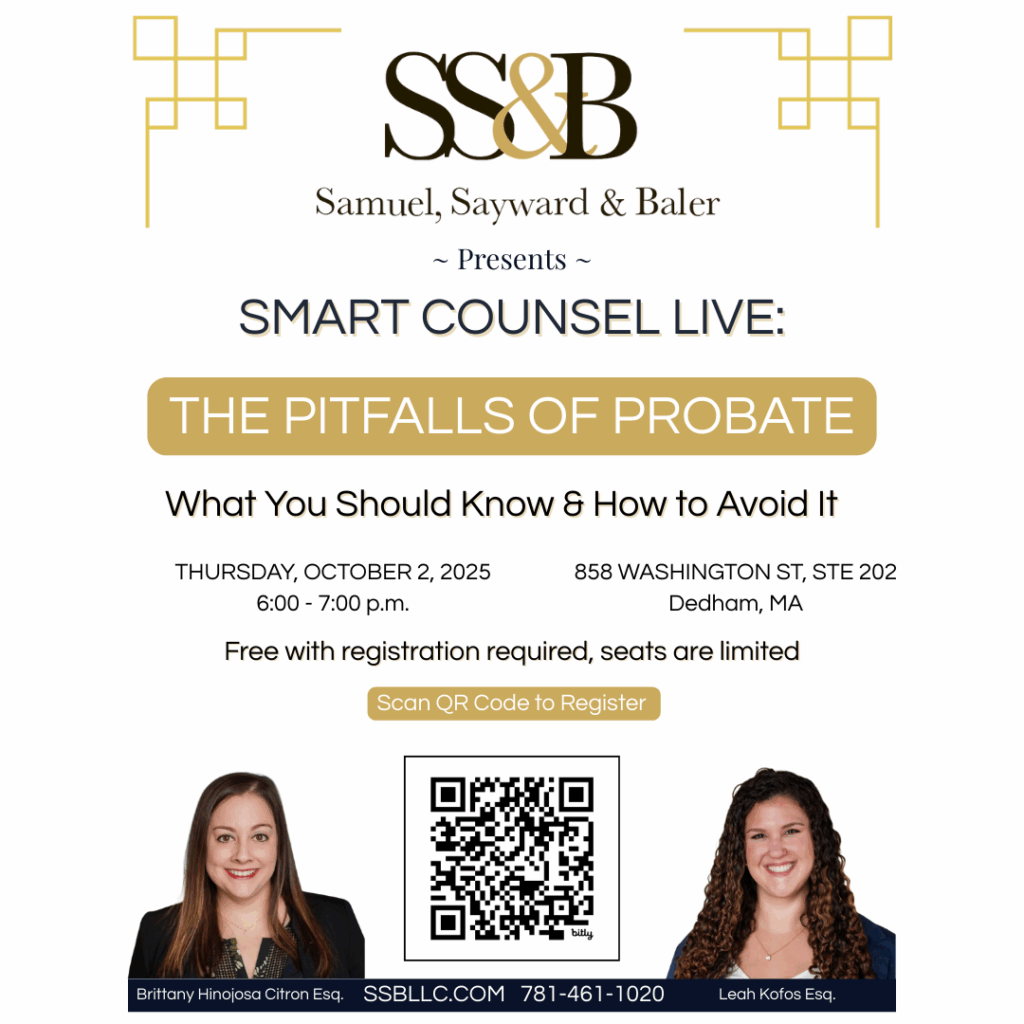
Join us for an exclusive seminar on the Pitfalls of Probate hosted by Attorneys Brittany Hinojosa Citron and Leah Kofos right here in the office at SSB. Learn what probate really means, how it works, and what you can do to prepare. Seats are limited – sign up today!
October 2, 2025 6:00 pm Samuel, Sayward & Baler, 858 Washington Street, Suite 202, Dedham, MA.
It’s no secret: lawyers can be costly. So it’s understandable that many people wonder if they really need one – especially when it comes to estate planning, probate, or administering a trust after someone dies. But here’s the reality: while lawyers may seem expensive upfront, the right lawyer can save you time, stress, and potentially much more money down the line.
If you’ve been named as a Personal Representative of a Will or Trustee of a Trust, you’ve been placed in a fiduciary role – which means that you’re legally obligated to act in the best interest of someone else. It’s not just a matter of paying some bills and distributing assets. You have real legal responsibilities and can be personally liable for mistakes.
Common pitfalls include:
Even innocent errors can result in disputes with beneficiaries or, worse, lawsuits. A skilled attorney helps you avoid these risks, providing clear guidance tailored to your specific duties and the laws of your state.
So how do you choose a lawyer?
Not all lawyers are created equal. Many attorneys market themselves as estate planners, focusing on drafting wills, trusts, and other planning documents. That’s an essential skillset — but not the only one you should look for.
If you’re choosing someone to help create your estate plan (or to guide you in a fiduciary role), look for an attorney who also handles estate and trust administration. Why? Because they bring a practical, experience-based perspective to the process.
An attorney who has seen how trusts and estates play out after death will draft better documents during life. They’ll know which provisions cause confusion, which funding methods lead to delays, and how to structure things to make life easier for your future Personal Representative or Trustee. They won’t just give you a binder full of documents — they’ll give you a roadmap to making it all work.
This insight can be the difference between an orderly, efficient estate process and one bogged down in costly delays, court involvement, or family conflict.
Legal documents often look good on paper. But the true test of an estate plan is how it functions in real life. An experienced attorney brings something critical to the table: the ability to distinguish between what’s technically legal and what actually works.
Let’s be honest: experienced lawyers aren’t cheap. But there’s a reason for that. You’re not just paying for documents or court filings – you’re paying for peace of mind.
A well-qualified attorney not only ensures that your documents are legally sound and tailored to your goals, but also that your Trust is properly funded, your fiduciary responsibilities are clearly defined and as easy as possible to carry out, and that potential risks are identified and addressed before they become costly issues. In essence, the right lawyer prevents a situation in which your loved ones are left to “just figure it out” after you’re gone.
If you’re taking on the responsibility of a fiduciary – or planning your own estate – investing in the right legal guidance now can prevent much greater expense (and heartache) later.
Bottom line: You don’t just need a lawyer – you need the right lawyer. One with real-world experience in both planning and administration. One who knows how things go wrong, and how to get them right. One who sees beyond the theory and helps you plan for real life. Yes, it may cost more upfront. But in the long run, it’s one of the best investments you can make – for yourself and for those you care about.
As the summer ends, the school year begins, and Halloween looms, the fun and games are over and our thoughts turn to two of our favorite topics, death and taxes. As you may know, the federal estate tax law allows you to leave $13.99 million to your heirs estate federal tax free. This federal estate tax “exemption” is scheduled to increase to $15 million on January 1, 2026, and will be indexed for inflation thereafter, allowing a married couple (with proper tax filings at the death of the first spouse to die) to leave a combined $30 million to their heirs free of federal estate tax. However, here in Massachusetts we are one of only twelve states and the District of Columbia that impose a separate state estate tax. If you live in Massachusetts or own real estate here it is understandable why death and taxes may be two of your favorite topics, since there is much to talk about. Here are five things to know about the Massachusetts estate tax.
1. Massachusetts Estate Tax Exemption. The Massachusetts estate tax is a one-time tax due nine months after death and based on the value of the assets owned by the deceased person on the date of their death. The law changed effective January 1, 2023, to increase the Massachusetts estate tax exemption to $2 million. The exemption is the amount you may leave to your heirs without paying any estate tax. Previously, the Massachusetts estate tax exemption stood at $1 million; however, that was more like a cliff than an exemption. If the value of the estate at death was over $1 million in value, the estate was taxed starting at the first dollar of value. With the recent estate tax change, Massachusetts has a true $2 million exemption, which means the estate is taxed only on the amount over $2 million. Massachusetts imposes estate tax based on a graduated rate schedule ranging from 7.2% for estates just over $2 million to 16% for estates over $10 million. For example, if you die with assets of $2.5 million in Massachusetts, the estate tax due would be approximately $39,200. If you die within an estate of $5 million your estate will pay an estate tax of approximately $292,000.
2. Eliminating or Deferring the Estate Tax Due. There are ways to eliminate or defer the estate tax that may be payable at your death. Assets left to charity pass free of estate tax. If you are feeling especially generous and leave your entire estate to a charity, regardless of the value of your estate, there will be no estate tax payable at your death. Most people who are married leave their estate to their spouse, and this will also result in no estate tax payable at the death of the first spouse to die. However, at the death of the surviving spouse, when assets typically pass to children or other family members, an estate tax will be due if the value of the surviving spouse’s estate exceeds $2 million. Certain trusts can be prepared as part of an estate plan that addresses estate tax planning, typically called “credit shelter trusts,” that can shelter a portion of the estate of the first spouse to die in trust for the benefit of the surviving spouse in such a way that those trust assets are not taxed in the surviving spouse’s estate. These types of trusts are commonly used to significantly reduce (if not completely eliminate) the estate tax that will be paid at the surviving spouse’s death, thereby saving taxes for the children or the heirs who inherit the estate after the surviving spouse passes away. There are other types of trusts that can be used to further reduce the estate tax for larger estates.
3. Deathbed Gifts. A discussion of death and taxes would not be complete without a mention of deathbed gifts. In Massachusetts, it is possible to make gifts immediately before death and have those gifts not be considered part of the taxable estate of the gift giver. Therefore, if you have a taxable estate and are in poor health, you might consider making gifts of assets to your heirs prior to your death in order to reduce the estate tax that will be paid after your death. Cash is an excellent asset to give in these circumstances. It is very important to keep in mind two things when making deathbed gifts: (1) if you make a gift of appreciated assets such as real estate or investments, the recipient takes the tax basis of the gift giver, and (2) when a person dies owning appreciated assets under current tax law the tax basis of those assets automatically increases at death to equal the value of the asset on the date of death (the so-called “step-up” in basis), essentially wiping out the unrealized capital gain on those assets. Therefore, in many circumstances, it is more valuable to retain highly appreciated assets until death, even if Massachusetts estate tax may need to be paid on the value of the estate, in order to eliminate the unrealized capital gain and the capital gain tax that would need to be paid if those assets are sold after death, as the capital gain tax is often greater than any estate tax that would be paid.
4. Getting Out of Dodge. Many clever folks think about moving to another state to avoid the Massachusetts estate tax. In a word, this is easier said than done. Many of our fellow New England states also have their own separate state estate tax (Vermont, Maine, Rhode Island, Connecticut). If you are considering a move to the lovely state of New Hampshire, which does not have a separate state estate tax, keep in mind that the Massachusetts Department of Revenue will closely examine your ties to Massachusetts at your death to determine if you were domiciled in this state and are therefore subject to Massachusetts estate tax – even if you claim to live in another state. There are many factors the state looks at, including things like where you file your state income taxes, where your doctors are located, where you vote, where your cars are registered, where you belong to clubs and organizations, and where your bills are mailed. For income tax purposes, the length of time you spent in the other state is important, however for estate tax purposes where you intend to be domiciled is crucial. And if you continue to own real estate in Massachusetts, see consideration #5 below.
5. Non-Residents Owning Massachusetts Real Estate. The recent updates to the Massachusetts estate tax law clarified that if you are Massachusetts resident owning real estate in another state, the value of that out of state is real estate is not includable when calculating the value of your Massachusetts estate on which Massachusetts estate tax is payable. However, if you are an out of state resident owning Massachusetts real estate, you may owe Massachusetts estate tax to the Commonwealth of Massachusetts at your death proportionate to the value that real estate bears to your total estate if the value of your total estate is in excess of the Massachusetts estate tax exemption. Therefore, for those of you intending to keep your house on the Cape and move to New Hampshire to avoid Massachusetts estate tax, be aware that you will not avoid the tax completely even if you successfully change your domicile to New Hampshire. There may be strategies that can be used to change the nature of what you own in order to avoid the estate tax, but this must be done taking into account all the facts and circumstances.
There are so many interesting things to know about the Massachusetts estate tax. Every client’s situation is unique in terms of the value of their assets, the type of assets they own, who their beneficiaries are, how the estate and capital gain tax laws will impact their estate at their death, and whether tax planning is appropriate and advised based on their goals and the nature of their assets. For all of these reasons, it is important to get the advice of an estate planning attorney with experience in estate tax planning if you have assets valued at more than $2 million and you are a Massachusetts resident or own real estate here. If you are interested in doing estate tax planning to reduce your estate tax as much as possible and preserve the maximum amount of your stay for your heirs, please be in touch – we are happy to assist you.
Attorney Leah A. Kofos is an associate attorney with the Dedham firm of Samuel, Sayward & Baler LLC, which focuses on advising its clients in the areas of trust and estate planning, estate settlement, and elder law matters. This article is not intended to provide legal advice or create or imply an attorney-client relationship. No information contained herein is a substitute for a personal consultation with an attorney. For more information visit ssbllc.com or call 781-461-1020.
© 2025 Samuel, Sayward & Baler LLC
Creating a trust is a smart step toward protecting your assets and making sure they are distributed according to your wishes. But setting up a trust is only half the job – funding it properly is what makes it work. Unfortunately, many people overlook this step, leaving their assets exposed to probate or other unintended consequences. Below are five crucial things you should know about funding your trust to ensure it does exactly what you want it to do.
1. If assets aren’t funded, then they won’t avoid probate. One of the biggest misunderstandings about trusts is the belief that simply signing the documents means your estate will avoid probate. Not so. If you don’t retitle your assets into your trust or name your trust as the beneficiary where appropriate, any assets held in your sole name stay outside the trust and will pass through your Will instead.
In that case, the assets will still make it to your trust – but first they have to go through the probate process. Probate can be time-consuming, expensive, and public – exactly what most people create a trust to avoid. Funding your trust correctly ensures that your wishes are carried out privately and efficiently, just as you intended.
2. Different types of accounts are funded differently! Funding your trust isn’t a one-size-fits-all process. Each type of asset has its own best method for being incorporated into your trust – and what works for one may not work for another.
Non-retirement accounts like checking, savings, or brokerage accounts are generally retitled into the name of your trust. In some cases, these types of assets may remain titled in the individual’s name and their trust is designated as the beneficiary. Life insurance policies can also name your trust as the beneficiary, which can be especially useful if you don’t want the proceeds going directly to young children or minors.
When it comes to retirement accounts like IRAs or 401(k)s, however, the trust is never the owner – only the beneficiary. And even then, naming the trust as the beneficiary must be done carefully. If you’re married, it’s usually recommended that your spouse be named the primary beneficiary to preserve certain tax advantages, with the trust listed as the contingent beneficiary. In some cases, it may even be beneficial to name individuals as beneficiaries instead of your trust, depending on your goals and the terms of your trust.
Every family situation is unique, so it’s essential to get specific advice from an experienced estate planning attorney to ensure your designations are right for you and won’t cause unintended tax consequences.
3. You May Need to Provide a Certification of Trust. When you transfer accounts into your trust, banks or financial institutions will want proof that the trust exists and that you have the authority to act for it. The law says that financial institutions can rely on a document called a Certification of Trust, which summarizes the key provisions without revealing all the private details like beneficiaries. However, some banks have stricter internal policies and may demand to see the entire trust agreement. In some cases, banks and financial institutions may ask to see the original documents, not copies. As such, when you’re funding your trust, be prepared to provide this documentation and always keep your original documents safe. If the bank employee insists on seeing your original trust, don’t leave the bank until you get your original trust back.
4. Remember Future Assets! Funding your trust isn’t a one-time project. Life changes and so will your asset portfolio. People often acquire new bank accounts, investment accounts, or real estate after their initial trust funding, but forget to transfer these new assets into the trust. One of the reasons to have regular check in meetings with your estate planning attorney – every two to five years – is to review your trust funding. These check-ins help you catch any gaps before they create big headaches later.
5.Get Confirmation and Keep Records. Sometimes, even when you’ve done everything right on your end, banks or insurance companies drop the ball. It’s not uncommon for a bank to say they’ve changed the title or beneficiary designation but then fail to follow through. Or they might update one account but not another held with the same institution.
Always get written confirmation that your accounts have been retitled correctly or that beneficiary designations have been updated. Keep copies of this paperwork with your trust documents. This simple step can save your family from confusion and delay down the road.
Every situation is different, and your trust should reflect your unique life, family, and objectives. A well-drafted trust is a powerful tool, but it’s only effective if it’s properly funded and maintained over time. A good estate planning attorney will give you written instructions on how to properly fund your trust based on your assets and your specific goals. By understanding how each of your assets should be titled or designated, keeping clear records, and checking in regularly with your estate planning attorney, you ensure your plan stays current with your life’s changes. With your trust fully funded, you can rest easier knowing you’ve done everything you can to protect your legacy and provide for the people and causes that matter most to you.
Attorney Leah A. Kofos is an associate attorney with the Dedham firm of Samuel, Sayward & Baler LLC, which focuses on advising its clients in the areas of trust and estate planning, estate settlement, and elder law matters. This article is not intended to provide legal advice or create or imply an attorney-client relationship. No information contained herein is a substitute for a personal consultation with an attorney. For more information visit ssbllc.com or call 781-461-1020.
© August 2025 Samuel, Sayward & Baler LLC
Protect Your Summer Sanctuary: Put That Beach House in a Trust
Summer is in full swing – the beach towels are out, the sunscreen is packed, and your family is headed to your beloved vacation home for another season of treasured memories. Maybe it’s the Cape Cod beach house, a lakeside cabin in New Hampshire, or that cozy coastal cottage in Maine that’s been in your family for decades. It’s the place where your kids learned to swim, where you host lobster boils, and where you slow down enough to hear the waves and feel the breeze. It’s more than just a house – it’s a backdrop for some of your family’s happiest moments.
And because your vacation home holds so many cherished memories, it deserves just as much care and planning as your primary residence – maybe even more.
Here’s where many people get tripped up. Lots of homeowners are diligent about putting their primary home into a trust. They know it helps their family avoid the hassle and expense of probate when they pass away. But too often, they forget to include their second home. And this oversight can cause real headaches down the line.
When you pass away, any real estate you own in your individual name has to go through probate. If you pass away and your vacation home isn’t in trust, it will go through probate. That means your vacation home becomes part of the public probate process, subjecting your family to delay, expense and aggravation just to transfer ownership of a place that should simply stay in the family. That’s extra paperwork, extra time, extra costs, and extra headaches for your loved ones at a time when they least want to deal with any of that. Probate eats up time and money, often taking months or even years to finalize. And during that time, the house may sit in limbo — maintenance, taxes, and utilities still need to be paid, but your family can’t easily sell it, rent it, or even make certain repairs without the court’s permission.
And here’s the kicker: if your vacation home is in another state – which is pretty common in New England – your heirs could be looking at two probates. For example, if you live in Massachusetts but own a cottage on Lake Winnipesaukee in New Hampshire, your family may have to file a probate in Massachusetts for your main estate and in New Hampshire for the cottage. This is called “ancillary probate.” Two sets of attorneys, two court processes, double the paperwork, double the fees – and double the stress for your loved ones at a time when they’d much rather be remembering you over a clam bake than sitting in a lawyer’s office.
Transferring your vacation home to trust will allow your to family avoid that hassle. With a properly funded trust, your property passes directly to your chosen beneficiaries without probate. No court dates, no drawn-out legal process, and no unnecessary expenses eating away at your estate. Instead, your family gets to focus on what matters most – keeping the traditions alive and the memories growing. A trust makes it clear who inherits the home, how it’s managed, and even how expenses like taxes and maintenance are handled. It also keeps the property out of the public eye – unlike probate.
Of course, every family and every vacation home is unique. Maybe yours is rented out during the off-season. Maybe it’s owned jointly with other relatives already. Maybe you’re thinking about passing it down to multiple kids who all live in different states. An experienced estate planning attorney will help you determine the best way to handle these details.
So while you’re enjoying long sunny days, sticky s’mores, and salty swims, take a moment to check your estate plan. Is that vacation home in a trust? If not, talk to an estate planning attorney. Updating your plan now means your family can keep the good times rolling – without any unexpected legal storms on the horizon.
Your summer sanctuary deserves protection – and your family deserves peace of mind. With a little planning today, you can make sure your beach house stays the joyful escape it’s meant to be – not a surprise headache for your heirs. Here’s to sunsets, sandcastles, and a future that’s just as relaxing as your favorite summer day.
Attorney Leah A. Kofos is an attorney with the Dedham firm of Samuel, Sayward & Baler LLC, which focuses on advising its clients in the areas of trust and estate planning, estate settlement, and elder law matters. This article is not intended to provide legal advice or create or imply an attorney-client relationship. No information contained herein is a substitute for a personal consultation with an attorney. For more information visit ssbllc.com or call 781-461-1020.
© 2025 Samuel, Sayward & Baler LLC
Attorney Leah Kofos discusses Incapacity Documents for Recent Grads, for our Smart Counsel for Lunch Series. Please watch and if you have any questions or want to learn more please call us at 781 461-1020.
“I want to give some money to my child – is that okay to do?” I often hear this question from elderly clients who visit me for the purpose of long-term care planning. The short answer: Yes, you are free to gift a certain amount to your adult children without filing a gift tax return. But here’s the catch – what seems like a generous gesture today could create serious issues down the line if you ever need Medicaid to help pay for nursing home care.
Let’s break it down. As of January 1, 2025, you can gift up to $19,000 per person per year without needing to file a federal gift tax return. This is the annual gift tax exclusion amount for 2025. Annual exclusion gifts may be made to multiple recipients. For example, you may give $19,000 to each of your children, Alvin, Simon, and Theodore, during 2025. If you are married, each spouse may give $19,000 to each child, meaning that Alvin, Simon, and Theodore may each receive a total of $38,000, allowing you and your spouse to gift $114,000 in 2025 without filing federal gift tax returns.
Sounds great, right? But here’s where things get complicated.
If you need Medicaid to pay for nursing home care within five years of making those gifts, the money you gave away could come back to haunt you. Medicaid has both medical and financial eligibility requirements. Upon application for such benefits, MassHealth (the agency that administers the Medicaid program in Massachusetts) will require an applicant to provide detailed financial information going back five years. This includes disclosing any gifts made during that period. If you made gifts during the so-called five-year look-back period, Medicaid considers the gifts to be “disqualifying transfers.” The logic is simple: if you’d held onto that money, you could have paid for your own care. By giving it away, you’ve essentially reduced your assets to qualify for government help – and that’s a red flag for Medicaid.
If Medicaid determines the gifts are disqualifying transfers, the person who made the gift will be ineligible for benefits for some period of time. The only way to avoid the penalty? The gift must be returned – which isn’t always practical or even possible. The real kicker is that the period of ineligibility does not begin until the applicant “would have otherwise been eligible.” That means the disqualification period for making a gift begins after the applicant has run out of money. And keep in mind, this trap for the unwary doesn’t just apply to cash gifts. Giving away property, like a house, counts too.
There’s absolutely nothing wrong with wanting to help your children financially – but when it comes to significant gifts, timing and strategy matter. As you grow older or start thinking about the possibility of needing long-term care, it’s essential to consult with an experienced attorney who can help you avoid costly mistakes. Thoughtful planning today can spare you and your family a great deal of stress and financial strain down the road.
Attorney Leah A. Kofos is an associate attorney with the Dedham firm of Samuel, Sayward & Baler LLC, which focuses on advising its clients in the areas of trust and estate planning, estate settlement, and elder law matters. This article is not intended to provide legal advice or create or imply an attorney-client relationship. No information contained herein is a substitute for a personal consultation with an attorney. For more information visit ssbllc.com or call 781-461-1020.
© 2025 Samuel, Sayward & Baler LLC
Please note we only are only able to serve clients with legal matters pertaining to Massachusetts.
Samuel, Sayward & Baler LLC
858 Washington Street, Suite 202
Dedham, MA 02026
781-461-1020 (phone)
781-461-0916 (fax)
©2026 Samuel, Sayward & Baler LLP. All Rights Reserved. The information presented on this website should not be construed to provide legal advice, nor does it constitute the formation of an attorney/client relationship. Read the disclaimer.