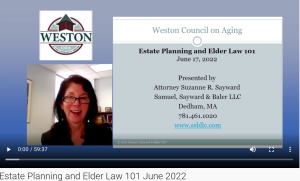
Attorney Suzanne Sayward discusses Transferring A Title For A Car After Someone Has Passed Away for our Smart Counsel for Lunch Series. Please watch and if you have any questions or want to learn more please call us at 781 461-1020.
Blog
Pay Attention to your Deed
A Deed is a document that determines the ownership of real estate. When you purchase your home or other real estate, or if property is given to you, the person transferring the property to you (the Grantor) gives you (the Grantee) a Deed to the property, which is signed by the Grantor and recorded at the Registry of Deeds. For most people, that is the last time they look at their Deed.
In the old days, an original Deed (or Certificate of Title for registered land) was an important document, and people often kept them in their safe deposit box. Over the past decade, land records in Massachusetts have become fully electronic. Once a Deed is recorded at the Registry of Deeds, the electronic copy of that document is the one that matters.
It is possible for you to look at the most recent Deed to your property (or to your neighbor’s property for that matter), your most recent mortgage, homestead, or any other document that has been recorded at the Registry of Deeds on the website for the Registry of Deeds for the county in which your property is located. Go to www.masslandrecords.com, select your county from the state map, and then search for your name.
From an estate planning perspective, your Deed determines the ownership of what is probably your most valuable asset – your home. As part of creating an estate plan, your estate planning attorney should review your Deed to make sure the way your property is owned is consistent with your estate planning goals.
There are various ways to own real estate in Massachusetts if two or more people own property, and the form of tenancy is generally noted after the name of the Grantee. For example:
- A Deed to “John Smith and Jane Smith as tenants in common” means that John and Jane each own a 50% interest in the property independent of each other. If John dies, his interest will not pass to Jane, and will instead pass according to his Will, or if he does not have a Will according to the intestate laws.
- A Deed to “John Smith and Jane Smith as joint tenants with rights of survivorship” means that if John or Jane dies, his or her interest will pass automatically to the surviving owner, and will not be controlled by the provisions of John or Jane’s Will.
- A Deed to “John Smith and Jane Smith, husband and wife as tenants by the entirety” is the form of joint ownership for married couples in Massachusetts, and as above in the case of “joint tenants”, the property will pass to the surviving spouse on the death of the first spouse.
- A Deed to “John Smith and Jane Smith”, with no tenancy indicated after the names of the Grantees, means the property is owned as tenants in common. Not indicating a tenancy on a Deed to two or more people is often an oversight that can have serious consequences. A probate proceeding will be required at the death of an owner of the property. This is particularly unfortunate when the lack of tenancy on the Deed goes unnoticed until just prior to the sale of the property, in which case the sale will be significantly delayed, if not lost, until a probate proceeding is commenced and a Personal Representative can be appointed for the deceased owner’s estate.
For estate planning purposes, property may be transferred from an individual’s name to a Trust to avoid probate, or for estate tax savings or asset protection reasons. However, if your Deed is and will remain in your individual name, it is important to make sure the way you own your property is consistent with your planning goals.
It is important that the Deed to your property not be changed by anyone but an attorney who is experienced in real estate matters. Mistakes in the names of the Grantor or the Grantee, in the type of tenancy indicated, or in the legal description of the property being purchased or transferred, can create serious title issues, delays, expense and no end of headaches.
I was recently surprised to hear from a client that a bank, in connection with a mortgage loan transaction, changed the deed to the client’s property to add a child on to the deed. This change, although accomplishing the bank’s objectives regarding the mortgage transaction, changed the manner in which the property will be owned following the client’s death in a way that was not at all consistent with the client’s wishes or the client’s estate plan. Transferring title to real estate falls under the category of things you should not undertake on your own, nor should you sign a Deed prepared by someone else without having an attorney review the Deed and discuss with you any implications of the change in ownership.
Changing a Deed can also have tax implications, can expose the property to the creditors of a new owner, and can void Homestead protection. There is no end to the headaches and unintended consequences that can result from changes to your Deed, whether properly drafted or not. Take a look at the Deed to your home, make sure that the ownership reflected on the Deed reflects your wishes, and if it does not, or if you are not sure, ask your estate planning attorney to review it with you to be sure it is consistent with your planning goals for that property.
Maria Baler, Esq. is an estate planning and elder law attorney and partner at Samuel, Sayward & Baler LLC, a law firm based in Dedham. She is also a former director of the Massachusetts Chapter of the National Academy of Elder Law Attorneys (MassNAELA), and the immediate past President of the Board of Directors of the Massachusetts Forum of Estate Planning Attorneys. For more information, visit www.ssbllc.com or call (781) 461-1020. This article is not intended to provide legal advice or create or imply an attorney-client relationship. No information contained herein is a substitute for a personal consultation with an attorney.
June 2022
© 2022 Samuel, Sayward & Baler LLC
Green Burials and Estate Planning
Attorney Megan Bartholomew discusses Green Burials for our Smart Counsel for Lunch Series. Please watch and if you have any questions or want to learn more please call us at 781 461-1020.
Five U.S. Supreme Court Decisions that Impacted Estate Planning
Last month’s leak of a draft U.S. Supreme Court opinion that would overturn the constitutional right to abortion in most circumstances has led to the Court dominating the news yet again and serves as a reminder of the far-reaching consequences of the Supreme Court’s decisions. Although the handful of decisions on hot-button issues released by the Court every June frequently dominate the headlines and the public’s conception of what the Court does, it is important to remember that the Supreme Court also hands down numerous “under-the-radar” decisions that have far-reaching impacts on all areas of the law, including estate planning and elder law. As the month of June begins and the Court prepares to wrap up another term, We thought now would be a good time to showcase five Supreme Court decisions that have impacted estate planning and elder law.
- Nichols v. Eaton (1875): Considered by some legal scholars to be the most important trusts and estates opinion ever produced by the Supreme Court, it could be argued that this decision laid the foundation for modern estate planning. Decided nearly 150 years ago, this case validates the use of “spendthrift clauses” in trusts. A spendthrift clause prohibits the beneficiary(ies) of a trust from transferring their interest(s) in the trust to a third party, either voluntarily or involuntarily. While this prevents, e.g., an impatient beneficiary from selling their income interest in a trust in exchange for a lump sum, far more consequentially, it also prevents potential creditors (including those with valid claims) from accessing a beneficiary’s interest in the trust. This means that, so long as a beneficiary’s interest stays in the trust, their creditors will not be able to access it or benefit from it. In the wake of this decision, spendthrift clauses have become ubiquitous in modern estate plans, to the point that it is rare to see a modern trust that doesn’t contain a spendthrift clause. It is the validity and enforceability of spendthrift clauses that makes the use of lifetime continuing trusts increasingly popular and common in modern estate plans.
- United States v. Windsor (2013): It is a happy coincidence that the Supreme Court’s tradition of releasing opinions on hot-button issues in June has meant that several monumental decisions affecting LGBTQ rights have been issued during Pride Month, giving members of the LGBTQ community added reason to celebrate each June. Among those decisions was United States v. Windsor, which struck down the Defense of Marriage Act nearly a decade ago. Signed into law in 1996, among other things the Act defined “marriage” as between one man and one woman for purposes of federal law, meaning that even if a same-sex couple was legally married under the laws of their state, that marriage was not recognized by the federal government. As a result, married same-sex couples were unable to, e.g., file joint income tax returns, apply for survivor’s Social Security benefits upon the death of a spouse, take advantage of the more favorable asset limits for married couples applying for Medicaid long-term care benefits, or take advantage of the unlimited marital deduction for federal gift and estate taxes. This frequently resulted in estate and long-term care planning for same-sex married couples being more complicated and costly while still not always achieving the same outcomes that were possible for opposite-sex married couples. Fortunately, the Windsor decision more or less leveled the playing field for same-sex married couples, and recent actions by lower federal courts have attempted to remedy some of the wrongs suffered by same-sex married couples while the Act was in effect.
- Clark v. Rameker (2014): This case deals with creditor protections for tax-qualified retirement assets (e.g., 401(k)s, IRAs, etc.). While federal law has long protected these assets from the reach of creditors in bankruptcy proceedings, this case dealt with whether this protection extends beyond the original contributor to the plan to also cover beneficiaries who inherited these assets. The Supreme Court ultimately held that the creditor protection only applies to the original contributor and their surviving spouse, and not to inherited beneficiaries, ultimately changing the calculus for estate planners in terms of whether to name a trust or an individual as the beneficiary of such assets. By naming a lifetime continuing trust with a valid spendthrift clause as the beneficiary of these assets as opposed to an individual, it is possible to maintain creditor protection for these assets.
- Sveen v. Melin (2018): While it is undoubtedly best practice to update beneficiary designations after a divorce, for a variety of reasons this doesn’t always happen. As a result, many states, including Massachusetts, have enacted “revocation-upon-divorce” laws, which automatically revoke the designation of an ex-spouse as the beneficiary of, e.g., a life insurance policy. In 2018, the Supreme Court was asked to decide whether the Constitution permitted these laws to apply retroactively to beneficiary designations made prior to their enactment. While the Court ultimately held that these laws can apply retroactively, the protracted litigation in this case nonetheless highlights the importance of making sure to update your estate plan, including beneficiary designations, in the wake of major life changes such as divorce.
- North Carolina v. Kimberley Rice Kaestner 1992 Family Trust (2019): In the modern era, it is more common than ever for families to wind up spread out across the country. Gone are the days where multiple generations of a family can be counted on to live in the same town or even the same state. This makes it more likely that a trust will be created in one state, have a trustee in a different state, and have beneficiaries in one or more additional states. With the only constants in life being death and taxes, it is not surprising that all of these states might want to impose taxes on this one trust. Fortunately, the Supreme Court has taken notice of this and begun to establish guidelines for when states are constitutionally permitted to tax a trust. In 2019, the Court held that the mere fact that a discretionary beneficiary of a trust (i.e., a beneficiary who had no right to demand or force distributions from the trust) lives in a state is not sufficient to give that state the authority to tax the trust. Although this decision was fairly fact-specific, it nonetheless has provided some guidance to estate planners on the tax consequences of trusts that touch multiple states.
With the exception of the Windsor case, which was hotly contested and decided on a 5-4 basis with three rather vociferous dissenting opinions, none of the Supreme Court cases mentioned here were particularly controversial or headline-grabbing. In fact, most dealt with fairly technical issues of interpretation. Nonetheless, they should all serve as reminders that even “boring” decisions by the Supreme Court can have a far-reaching impact on the law.
June 2022
© 2022 Samuel, Sayward & Baler LLC
Full Webinar – Demystifying the use of Irrevocable Trusts for Long Term Care Planning
Attorneys Suzanne Sayward and Frank Mulé present the advantages and disadvantages of using an Irrevocable Trust to protect assets from having to be spent-down on long-term care costs in our most recent Smart Counsel Webinar.
Is a Voluntary Probate Right for You?
By Attorney Abigail V. Poole
After a loved one passes away, sometimes probate of one or more assets held in the deceased’s name is necessary. Probate is the process by which a person is given legal authority by the court to access, manage and distribute the assets titled in the individual name of the deceased at the time of death. There are three (3) common types of probate in Massachusetts from which to select depending on assets, family dynamics, and other factors. The simplest, quickest and least expensive type of probate is a voluntary administration.
A voluntary administration is available if the deceased died with $25,000 or less in total probate assets, plus not more than one (1) vehicle in his or her individual name. Other than the vehicle, the assets can be bank accounts, certificates of deposit, unclaimed property, stock, and savings bonds. However, a voluntary administration may not be filed for estates where the decedent owned an interest in real estate. If a Voluntary Personal Representative later discovers assets that cause the total estate value to be more than $25,000 or the Voluntary Personal Representative requires full legal authority to administer an aspect of the estate, the voluntary administration can be converted to one of the other types of probate.
A great example of when a voluntary administration may be a good fit is the situation where the surviving spouse discovers $15,000 of stock in the deceased spouse’s individual name. The surviving spouse may file a voluntary administration and once the voluntary statement is certified by the court, that surviving spouse will be able to gain access and direct the sale of the stock and distribution of the proceeds, or direct the transfer of the stock to him- or herself.
At Samuel, Sayward and Baler LLC, an experienced attorney will assess the deceased’s assets and other relevant information to assist you with determining the type of probate that best fits your situation. This thoughtful and comprehensive approach to filing for the most suitable probate process means that you will be better prepared to confidently address your current and future estate responsibilities.
Attorney Abigail V. Poole is an associate attorney with the Dedham firm of Samuel, Sayward & Baler LLC which focuses on advising its clients in the areas of trust and estate planning, estate settlement and elder law matters. She is an active member and current President Elect of the Massachusetts Chapter of the National Academy of Elder Law Attorneys (NAELA). This article is not intended to provide legal advice or create or imply an attorney-client relationship. No information contained herein is a substitute for a personal consultation with an attorney. For more information visit ssbllc.com or call 781/461-1020.
May, 2022
© 2022 Samuel, Sayward & Baler LLC
Top 5 Reasons to Create an Estate Plan During National Elder Law Month
Welcome to May! Not only is it the month of flowering trees, flowering shrubs, and well, flowering flowers, it is also National Elder Law Month. Elder law attorneys advise clients about a variety of issues, one of which is estate planning. However, estate planning is not just for older adults. As an estate planner and elder law attorney, I can cite a number of reasons why everyone over the age of 18 should have an estate plan. But what motivates most people to pick up the phone and make an appointment with an attorney to create their Will? I conducted a very un-scientific study of why clients decide to create or update their estate plan.
Here are the top five reasons that people decide to create or update their estate plan – in descending order.
5. They want to provide instructions for end-of-life care. Many people feel strongly about how they want to be cared for at the end of their lives. So long as someone is healthy enough to articulate instructions for their own care, they may direct the course of their care. But if a person is unwell and unable to articulate those instructions, then the only way their wishes can be carried out is if they have provided advance instructions about the care they wish to receive and appointed someone who has the legal authority to implement those instructions.
4. They want their estate to avoid probate. Probate avoidance is one of the primary reasons that people create an estate plan and rightfully so. Probate is the process of changing the title on assets when someone passes away from the deceased person’s name to the name of the legal representative for the estate. Probate is costly, it is a public proceeding, it invites contests and it takes a long time. Luckily, avoiding probate is fairly easy. Only assets that are in a person’s individual name at the time of death and that do not have a joint owner or beneficiary designated to receive them need to be probated. Owning assets jointly with another person (when appropriate), making sure there are beneficiaries designated on assets such as IRAs, 401Ks, annuities, and life insurance, and creating and funding a Living Trust, are all ways to avoid probate.
3. They want to reduce or eliminate estate taxes. The estate tax is a tax imposed on the value of assets an individual owns (or is deemed to own) at death. There is both a federal estate tax and a Massachusetts estate tax. The good news is that federal law gives each person a $12 million exemption from federal estate tax. As such, there are very few people who need to pay federal estate tax. The bad news is that Massachusetts grants its citizens only a $1 million freebie from estate tax. For many residents of Massachusetts who own a home, have a retirement account, and own life insurance, this $1 million threshold is quickly reached. Undertaking planning to reduce or eliminate the estate tax that their families will pay from their estates at death is a goal for many whose estate will subject to the estate tax.
2. They want to protect their assets from having to be spent down on long-term care costs. Many clients tell us they are concerned about the cost of long-term care and worried that those costs will consume all of their assets. Given the very high cost of long-term care, whether delivered at home or in a skilled nursing facility, these concerns are warranted. Learning about the options for planning to protect assets from needing to be spent down on long-term care well in advance of needing such care is vital to the success of achieving this goal. Learning the pros and cons of such planning, and why for some it may not be necessary, are also important. Long-term care planning is very specific to each individual, and is an area in which it is especially important for each client to get advice about their own particular circumstances.
1. They want to provide for and protect their loved ones. The number one concern that clients have is for their families. Whether it’s parents with young children, older folks with grown children, a married couple with no children, or the favorite auntie or uncle, they all want to make sure their loved ones are taken care of when they are no longer around to do so. This means different things at different stages of life. For parents of young children, it means naming guardians for those children and ensuring there are resources available to raise them. For those with adult beneficiaries, it may mean setting up their plan to provide creditor protection for the inheritance they leave to children or nieces and nephews. And for older couples, making sure that the survivor of them is left in the best possible circumstances upon the death of the first spouse is of paramount concern.
There are many reasons people make the decision to create or update their estate plan on a given day. Sometimes it’s circumstantial, such as the death of a loved one or a medical diagnosis. But underneath those circumstances is a desire to ‘get one’s house in order’. If we can help you with your estate or long-term care planning, please contact us to schedule a time to speak with one of our experienced estate planning and elder law attorneys.
Attorney Suzanne R. Sayward is a partner with the Dedham law firm of Samuel, Sayward & Baler LLC which focuses on advising its clients in the areas of estate planning, estate settlement and elder law matters. She is certified as an Elder Law Attorney by the National Elder Law Foundation, a private organization whose standards for certification are not regulated by the Commonwealth of Massachusetts. This article is not intended to provide legal advice or create or imply an attorney-client relationship. No information contained herein is a substitute for a personal consultation with an attorney. For more information visit our website at www.ssbllc.com or call 781/461-1020.
May, 2022
© 2022 Samuel, Sayward & Baler LLC
What’s New at Samuel, Sayward & Baler LLC – Don’t Miss Our April 2022 Newsletter
Don’t Miss Our April 2022 Newsletter
Attorney Suzanne Sayward discusses our most recent newsletter, for our Smart Counsel for Lunch Series. Please watch and if you have any questions or want to learn more then call us at 781 461-1020. Please find our newsletter below.
Demystifying the use of Irrevocable Trusts for Long Term Care Planning
To our Clients and Friends:
Please join us for the next presentation in our Smart Counsel Series on Thursday, May 19, 2022, from 6:00 pm to 7:30 pm in person* at our office at 858 Washington Street, Suite 202, Dedham, Massachusetts OR virtually via Zoom.
If you have ever wondered whether an Irrevocable Trust for long-term care planning is right for you, join us for this program, Demystifying Irrevocable Trusts for Long-term care Planning.
Attorneys Suzanne Sayward and Frank Mulé will discuss the advantages and disadvantages of using an Irrevocable Trust to protect assets from having to be spent-down on long-term care costs. Attendees (both in person and virtual) will have an opportunity to ask questions.
For those who attend in person, we’ll have wine, cheese and other light refreshments. For those who attend virtually, you’re on your own for snacks!
Contact Victoria Ung at 781/461-1020 or ung@ssbllc.com to reserve a spot for you and a friend.
The program is free but space is limited if you would like to attend in person, so don’t delay!
Suzanne R. Sayward
Maria C. Baler
Abigail Poole
Frank Mulé
Megan Bartholomew
* Subject to change. If rising COVID cases mean that we have to cancel our in person presentation, registrants will be able to attend virtually.
A Trap for the Unwary: Gifting and Long-term Care Medicaid Benefits
“I want to give some money to my child – is that okay to do?” I often hear this question from elderly clients who visit me for the purpose of long-term care planning. The short answer is that you are free to gift a certain amount to your adult children without filing gift tax returns but it may adversely impact your eligibility to receive Medicaid benefits to pay for long-term care in a nursing home later.
Let’s say you are contemplating giving $16,000 to your child. From a tax perspective, an individual is permitted to give up to $16,000 to a recipient each year without filing a federal gift tax return. This is the annual gift tax exclusion amount as of 2022. Annual exclusion gifts may be made to multiple recipients. For example, you may give $16,000 to each of your children Alex, Ben and Cathy during 2022. If you are married, each spouse may give $16,000 to each child, meaning that Alex, Ben and Cathy may each receive $32,000, allowing you to gift $96,000 in 2022 without filing federal gift tax returns.
However, gifting almost $100,000 to your children in 2022 will be problematic should you require Medicaid to pay for your long-term care in a nursing home within the five-year period following the gifts. Medicaid is a joint federal/state government benefits program that requires specific medical and financial criteria are met before someone is eligible for Medicaid benefits to pay for long-term care nursing home costs. Upon application for such benefits, MassHealth (the agency that administers the Medicaid program in Massachusetts) will require an applicant to provide detailed financial information going back five years. This includes disclosing any gifts made during that period. If you made gifts during the so-called five-year look-back period, Medicaid considers the gifts to be disqualifying transfers. The reasoning is that if you had retained the money you gifted to your children, you would have been able to pay for the nursing home expenses out of your own pocket instead of Medicaid paying for you.
If Medicaid determines the gifts are disqualifying transfers, the recipients must return the gifted money to you to “cure” the transfer so you can pay the nursing home costs out of pocket until you are financially eligible for Medicaid again. If the money is not returned, the person who made the gift will be ineligible for benefits for some period of time. The period of ineligibility is calculated by dividing the amount of the gift by the average daily cost of a nursing home as determined by the state (currently $410). For example, that $16,000 gift to your child would result in around 39 days of ineligibility for Medicaid benefits. The real kicker is that the 39 days of ineligibility does not begin until the applicant “would otherwise have been eligible”. That means the disqualification period for making a gift begins to run after the applicant has run out of money. This trap for the unwary applies not only to gifts of money but also to gifts of other assets, such as real estate.
Making gifts of your assets to your children while also planning for a future in which you may require long-term care in a nursing home requires careful navigation. At Samuel, Sayward and Baler LLC, an attorney experienced in long-term care planning can assist you with avoiding such traps so that you and your children have peace of mind in case long-term care is necessary.
Attorney Abigail V. Poole is an associate attorney with the Dedham firm of Samuel, Sayward & Baler LLC which focuses on advising its clients in the areas of trust and estate planning, estate settlement and elder law matters. She is an active member and current President Elect of the Massachusetts Chapter of the National Academy of Elder Law Attorneys (NAELA). This article is not intended to provide legal advice or create or imply an attorney-client relationship. No information contained herein is a substitute for a personal consultation with an attorney. For more information visit ssbllc.com or call 781/461-1020.
April, 2022
© 2022 Samuel, Sayward & Baler LLC
